
Guides · leases and notice
Why NSW leases end, and how to time your move when a landlord gives notice
Most NSW leases end because the renter decides to move; when a landlord ends one, the usual reasons are an owner or family moving in or a sale, and on a periodic agreement that means 90 days' notice for an owner move-in or proposed sale, 30 days for an actual sale, and the right to move out sooner.
Most NSW rentals end because the renter decides to go. The state's first End of Tenancy Survey found approximately 85 per cent of leases were ended by renters rather than landlord action. Where a landlord did end one, almost two-thirds of cases were owner or family moving back in (28 per cent), proposed sale (20 per cent), or actual sale (14 per cent).
Combining those two findings, the three reasons account for roughly 9 in every 100 leases that ended. That is our estimate, not a figure from the release. Here is the working: taking out the renters' 85 per cent leaves about 15 per cent ended by landlords. The three reasons add up to 62 per cent (28 plus 20 plus 14), and 62 per cent of that 15 is about 9.3 per cent.
If you are one of those nine, the reason sets your timeline. The notice is 90 days for proposed sale and landlord or family moving in on a periodic agreement or a fixed term over 6 months. It is 60 days on a fixed term of 6 months or less. An actual sale is 30 days on a periodic agreement. That is your window to find a home, book a removalist and hand back the keys. The section on leaving early shows you don't have to wait for the last day.
Why do most NSW leases end?
Bar 2 percentages are shares of landlord-ended leases, not of all tenancies.
The figures rest on a big sample. The survey drew over 275,000 responses from landlords and agents, around 90 per cent of bonds refunded in the period. Since 1 July 2025, landlords and agents must complete the survey when claiming or releasing a bond through Rental Bonds Online. They have 14 days from the initial claim, and tenants are asked voluntary questions.
The 28, 20 and 14 per cent figures describe only the leases a landlord ended, not every tenancy: roughly 85 per cent were ended by renters.
The change from the old rules is the reason itself. The release estimates that before the reforms about 45 per cent of leases ended without a reason given. A stated reason now comes with a set notice period, so a renter can plan a move to a date rather than to a guess.
That matters at scale. Around 330,000 renting households move in NSW each year. Most of those moves are chosen. This guide is for the ones that aren't.
How much notice does a landlord have to give in NSW?
The notice clock
Landlords cannot end a fixed term early except in special cases (breach, non-payment, unusable property and similar).
On a periodic agreement, the notice periods are:
- 90 days for proposed sale, significant renovations, change of use, and landlord or family moving in
- 30 days for actual sale
- 14 days for breach or non-payment of rent
Fixed terms work differently. For fixed terms of 6 months or less, it is 60 days for the 90-day grounds; for fixed terms of more than 6 months it is 90 days. Landlords cannot end a fixed term early except in special cases, such as breach, non-payment or a property that can't be lived in.
The notice period also runs the other way. A tenant ending a periodic tenancy gives 21 days' notice.
Check how your notice arrived. If a notice is posted, the landlord must allow an extra 7 working days for delivery. Count those before you pencil in a truck.
What should a termination notice include?
Check your notice
- NSW landlord ending a tenancy
- NSW landlord ending a tenancy
- NSW landlord ending a tenancy
- NSW landlord ending a tenancy
- NSW landlord ending a tenancy
- NSW minimum notice periods
- NSW landlord ending a tenancy
Missing required documents: the termination may not be valid. A tenant can challenge a notice as not genuine at NCAT.
A landlord's notice must be in writing, signed and dated. It must state the ground, come with a termination information statement, and include supporting documents where the ground requires them. For a proposed sale, the landlord must give the contract for sale or the agency agreement, and the sale must require vacant possession.
If a ground requires documents and none are given, the termination may not be valid. Giving false or misleading documents is an offence. A tenant can challenge a notice as not genuine at NCAT. The other side of that is also true: if the tenant does not vacate by the notice date, the landlord can apply to NCAT for a termination order.
Treat this as a checklist, not legal advice. If something on your notice doesn't add up, read the Tenants' Union factsheet on sale of rented premises before you start packing.
Can a landlord re-let the home after ending your lease?
| Reason the landlord gave | Cannot re-let for |
|---|---|
| Proposed sale | 6 months after the termination date NSW landlord ending a tenancy |
| Significant renovations | 4 weeks (work must start within 2 months of move-out) NSW landlord ending a tenancy |
| Demolition | 6 months NSW landlord ending a tenancy |
Periods range from four weeks to 12 months depending on the reason; only the reasons above are shown.
Not straight away. Landlords who evict cannot re-let within a set period, "ranging from four weeks to 12 months, depending on the reason". For a proposed sale, the re-letting exclusion is 6 months after the termination date. For significant renovations, the exclusion is 4 weeks, and the work must start within 2 months of move-out. For demolition, the exclusion is 6 months.
Stated reasons are checked. The Rental Taskforce uses data-matching to check stated reasons against rental listings and bond lodgements. In one May 2026 round, about 600 properties were flagged for possible exclusion-period breaches, leading to 13 formal warnings and 12 fines totalling $50,050 (checked November 2026).
Landlord selling: what happens before you move out?

A proposed sale usually means inspections while you still live there. The landlord must give 14 days' written notice before showings begin and 48 hours' notice before each showing. A tenant need not agree to more than 2 showings a week. There is no entry before 8am, after 8pm, or on Sundays or public holidays.
Our advice at St Ives Removals is to use those weeks to pack. Start with the rooms you use least and stack closed boxes against one wall, so a showing looks tidy rather than half-moved. Keep jewellery, documents and medication in one box that stays with you, not in the stack. Our guide to packing fragile and valuable items covers what to pack yourself and what to leave to a crew.
Can I leave early after a termination notice?
The notice date is the latest you can stay, not a day you must wait for. Under a periodic agreement you may leave any time before it and stop paying rent once you have left, and under a fixed term you give at least 14 days' early exit notice.
In practice, a 90-day notice can become a 40-day move if the right place comes up early. You set the moving date inside the window, which gives you more choice of removalist days.
If the next home is also a NSW rental, you can transfer an existing bond to a new NSW rental for a $25 fee (checked November 2026). The conditions: you must vacate within 4 weeks of entering the new home and move with the same tenants, and a claim in progress on the old bond blocks the transfer.
When should you book the removalist?
- Thu 17 Dec 2026: Term 4 ends
- Fri 18 Dec 2026 to Wed 27 Jan 2027: Summer school holidays (Eastern division)
- To 3 Feb 2027: Western division
Book as soon as you have a date, even a provisional one. Summer is the tight part of the year. NSW Term 4 ends Thursday 17 December 2026 and summer school holidays run Friday 18 December 2026 to Wednesday 27 January 2027 in the Eastern division.
Two dates show how notices fall into that stretch. Both are our own arithmetic, so check the date on your notice. A 30-day actual-sale notice handed over on 18 November runs to about 18 December, the first day of the holidays. A 90-day notice served on 1 October lands on about 30 December. A posted notice pushes either date later by the 7 working days above.
Once the date is fixed, the move planner helps you work backwards from it. What a written move plan contains shows what should be agreed in writing. If the shed holds a BBQ bottle, pool chemicals or a mower full of petrol, deal with those early: our guide on gas bottles, pool chemicals, petrol and aerosols explains what to do with each.
What to do in the last fortnight before you hand back the keys
Last fortnight, in order
- Confirm the moving date with your removalist
- Clear items removalists won't carry (gas bottles, pool chemicals, petrol)
- Photograph every room against your entry condition report
- Leave the property empty and in a similar condition to the start
- Final inspection with the landlord or agent
- Return all keys
- Update your address through Service NSW
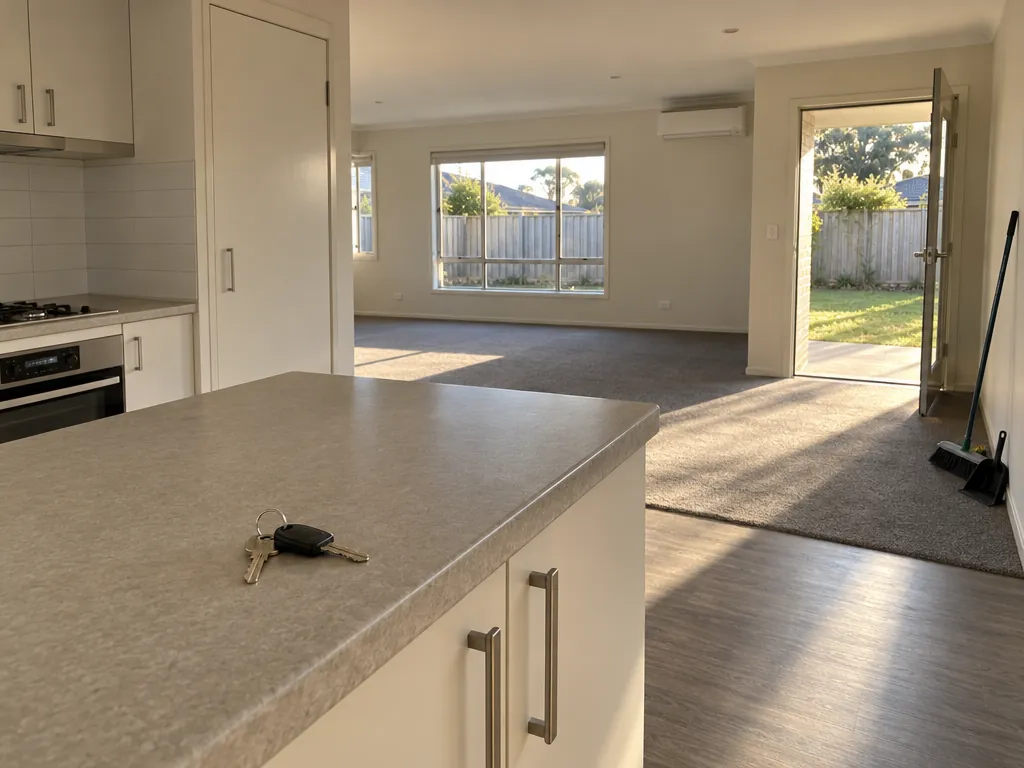
The official list is short. You must leave the property empty and in a similar condition to the start, keys returned, with a final inspection by the landlord or agent. After that, update your address through Service NSW.
Order matters more than people expect. Clean after the truck leaves, not before, because furniture hides scuffs and dust. Then photograph every room against your entry condition report, from the same angles if you can. Keep one set of keys back until the final inspection, so you can get in if something needs a second clean.
Your notice dates and rules on one page
- Leases ended by renters: approx. 85%NSW Government release
- Landlord-ended only: owner or family moving in 28% / proposed sale 20% / actual sale 14%NSW Government release
- 90 days: proposed sale, renovations, change of use, owner or family moving in (periodic, or fixed term over 6 months)NSW minimum notice periods
- 60 days: same grounds, fixed term of 6 months or lessNSW minimum notice periods
- 30 days: actual sale (periodic)NSW minimum notice periods
- 21 days: tenant ending a periodic tenancyNSW minimum notice periods
- Leaving early after a landlord notice: periodic, any time before the date; fixed term, at least 14 days' noticeNSW minimum notice periods
- +7 working days if the notice was postedNSW landlord ending a tenancy
- Re-letting exclusion: proposed sale 6 months; significant renovations 4 weeks; demolition 6 monthsNSW landlord ending a tenancy
- Smart Rental Bonds transfer: $25 (checked November 2026); vacate within 4 weeks of entering the new home, same tenantsNSW Smart Rental Bonds
Keep this with your notice. Every figure on it comes with its scope, because a 90-day rule on a periodic lease is a 60-day rule on a short fixed term.
Your next step
When the date on your notice is settled, or you have picked your own date inside it, the next job is the truck. Tell St Ives Removals your moving date, how flexible it is, and both addresses, and ask for a quote through the removalist quote page. Booking early gives you the widest choice of days.
Sources
- https://www.nsw.gov.au/ministerial-releases/greater-rental-market-transparency-delivered
- https://www.nsw.gov.au/housing-and-construction/renting-a-place-to-live/ending-a-residential-tenancy/understanding-tenancy-endings-through-landlord-and-agent-survey-data
- https://www.nsw.gov.au/ministerial-releases/millions-already-transferred-smart-rental-bonds
- https://www.nsw.gov.au/housing-and-construction/rules/minimum-notice-periods-for-ending-a-residential-tenancy
- https://www.nsw.gov.au/housing-and-construction/rules/landlord-ending-a-tenancy
- https://www.tenants.org.au/factsheet-28-sale-of-rented-premises
- https://www.nsw.gov.au/ministerial-releases/minns-labor-government-deploys-new-tech-to-crack-down-on-no-grounds-evictions
- https://www.nsw.gov.au/housing-and-construction/renting-a-place-to-live/residential-rental-bonds/smart-rental-bonds
- https://www.nsw.gov.au/about-nsw/school-holidays
- https://www.nsw.gov.au/housing-and-construction/renting-a-place-to-live/ending-a-residential-tenancy/moving-out-of-a-rental-home